The 4th of July is upon us once again! A time when many start thinking about the actions of those who helped form this country. Research regarding soldiers of the Revolutionary War is akin to traveling through the woods by bread-crumb trail – the pieces are few, far away from one another, and sometimes are non-existent. The biggest impediment of sold Revolutionary War records comes from how peace-meal the army was at the time and how frequently people deserted due to illness, drunkenness, or lack of pay.
With the release of Lin Manuel-Miranda’s musical Hamilton, many people are beginning the search for ancestors that fought in the Revolutionary War in hopes that they may have served with Alexander Hamilton himself. While I can’t claim that my ancestors played such a part, I do know that I am related to a few fellows who served during the time period.
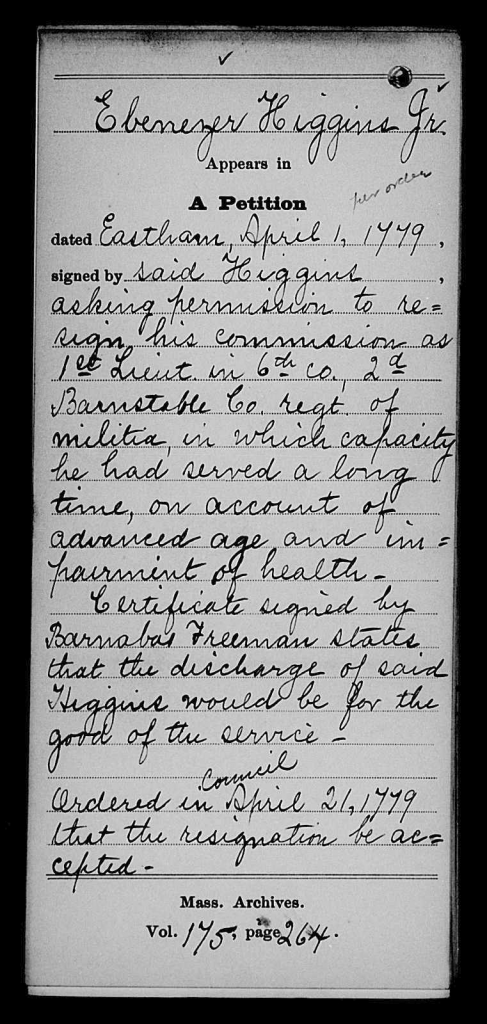
Ebenezer Higgins’ resignation was accepted in 1779. Source: US R.evolutionary War Rolls, 1755 – 1783
Ebenezer Higgins – 7th great-grandfather – Born July 21, 1721 at Eastham, Massachusetts,1 he served for many years as 1st Lieutenant in Capt. Elisha Doane’s 6th (2d Eastham) company of the Second Barnstable County regiment of militia. On April 26, 1776, Ebenezer was commissioned into active service at the age of 55 and served for another three years. It wasn’t until April 1, 1779, that he asked permission to resign on “account of advanced age and impairment of health.” Ebenezer’s resignation was officially accepted on April 21, 1779, and the age of 58 years.2
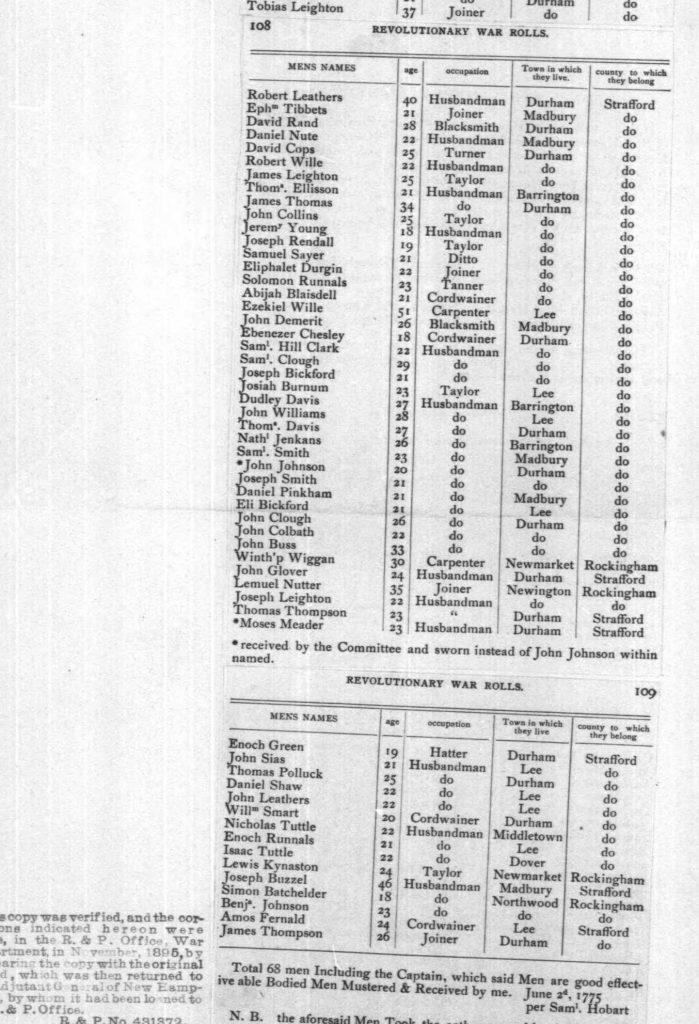
Shows Moses Meader accepted as a substitution for John Johnson. Source: US Revolutionary War Rolls, 1755 – 1783
Moses Meader – 6th great-grandfather – Born January 28, 1752, in Alton, New Hampshire,3 Moses entered into the Revolutionary War at age 23 in place of John Johnson. Moses served as a private under Captain Winborn Addams’ company in Colonel Enoch Poor’s regiment.4
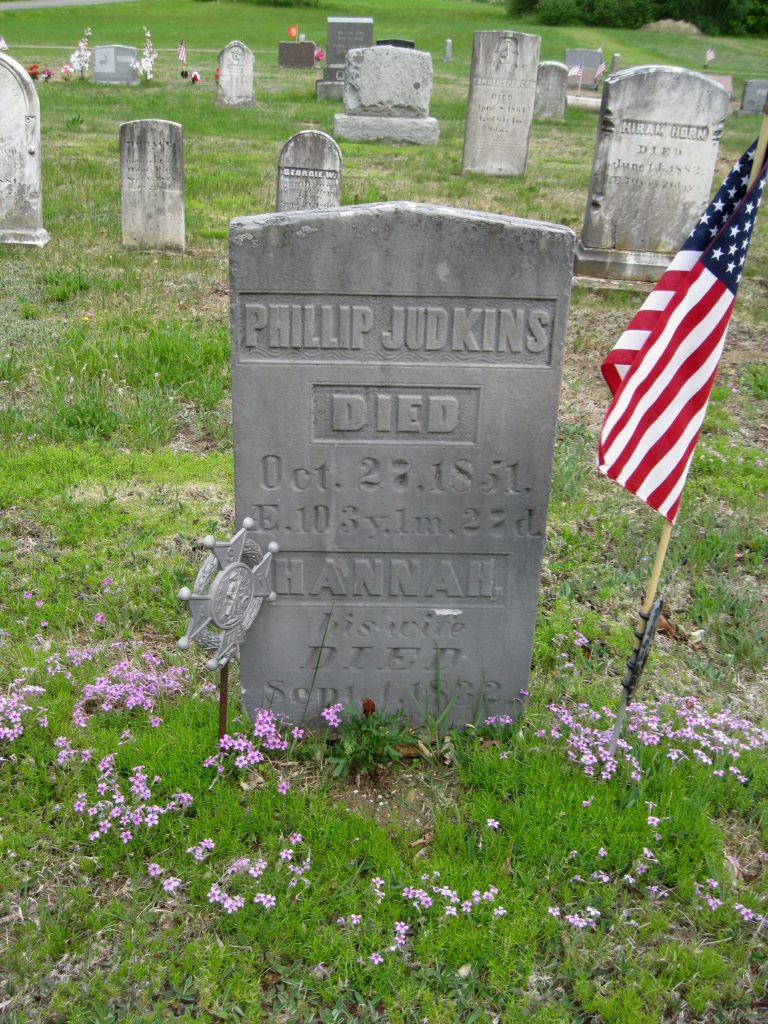
Philip Judkins stone at Cambridge Memorial Garden Cemetery. Photo Credit: SacredCat
Philip Judkins – 7th great-grandfather – Another New Hampshire native, Philip was born on August 29, 1748.5 He was a soldier in the company of Jason Wait, part of 1st New Hampshire regiment. Shortly before the end of the battle at Valley Forge, Philip was busted from Corporal back to Private,6 and additionally was written up for desertion twice, at least, once in 17797 and again in 1780.8 He is one of the few soldiers I found who used his own pension for his own needs – Philip lived to be 103 and most likely needed that pension to help cover his own costs of living while residing with family.9
Stephen Gardner – 6th great-grandfather – and Stephen Gardner Jr – 5th great-grandfather – While there are no records of either Stephen doing anything more than helping guard the shores of Dorchester, this “minor” action shows how common it was for the militia to help during the Revolutionary War in protecting the coastline.10
My search for Revolutionary War patriots on my lineage is far from over. Aside from these five men, there is the distinct possibility thatthe following ancestors may also have served during this time:
Ebenezer Andrews Ebenezer Andrews Jr Reuben Wing, Sr Joseph Wing Steven Landers Jacob Quimby Samuel White
1 American Genealogical-Biographical Index, database, Ancestry.com 2 US Revolutionary War Rolls, 1755 – 1783, database, Ancestry.com 3 New Hampshire Births and Christenings Index, 1714 – 1904, database, Ancestry.com 4 Compiled Service Records of Soldiers Who Served in the American Army During the Revolutionary War, compiles 1894 – ca 1912, documenting the period 1775 – 1784, roll 0522, image fold3.com 5 Maine Faylene Hutton Cemetery Collection, 1780 – 1990, Ancestry.com 6 Entry for Philip Judkins, ID# NH20759, http://valleyforgemusterroll.org/ 7 New York Historical Society (1916), The John Watts de Peyster Publication Fund Series vol 47, pg 312 8 New Hampshire (Colony) Probate Court (1874), Provincial and State Papers Vol. 8, pg 852 9 Maine Faylene Hutton Cemetery Collection, 1780 – 1990, Ancestry.com 10 Massachusetts Office of the Secretary of State (1896), Massachusetts soldiers and sailors of the Revolutionary-War – a compilation from the archives, pg 278
As with all written pieces of genealogical research, the findings in this piece are subject to change based on new evidence as it becomes known.
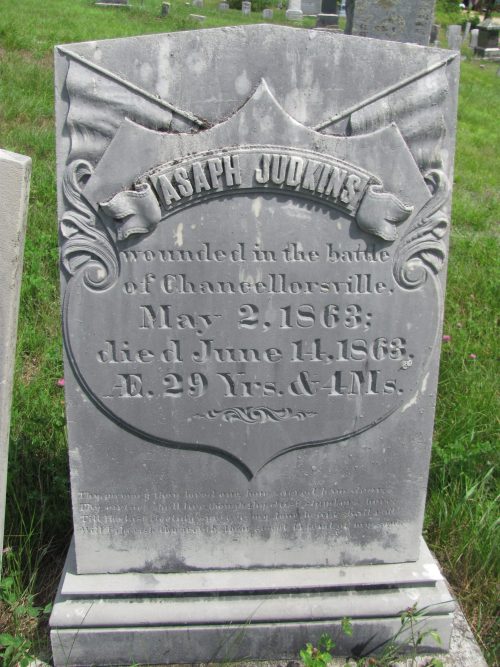
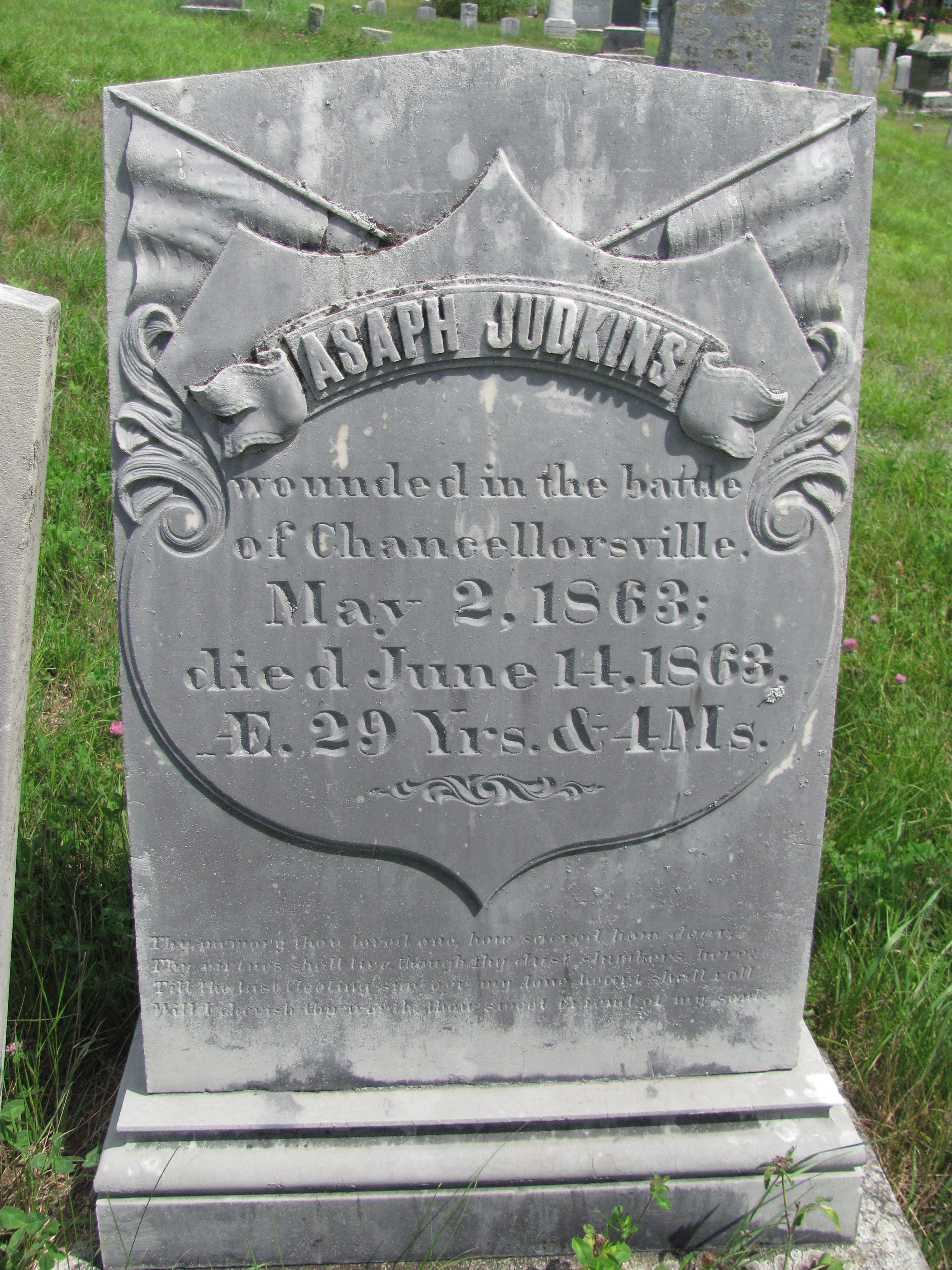
Asaph Judkins is the only brother lost to the Civil War to have a stone at Newman Cemetery. Photo credit: Gail Kelly
Growing up I always had a love for learning about the Civil War. It was an insatiable thirst which had no tangible reason to exist. Maybe it was because it was a war that held so much promise to bring our nation even closer together, to create a more just and stable union, a country for all people – and utterly failed. (If you don’t understand that last part, study the Antebellum years. A lot of schools in the US gloss over that and you’ll find out why.) Or it could have been that the war brought to a head the concept that a nation so large is bound to hold varying, and sometimes disastrously so, difference in morals and political views, an issue that still lingers. As a student, and now a parent, I feel that the Civil War is never studied deeply enough, especially when many of our nation’s current issues are rooted so tightly to the outcome and lack of follow-up from that war.
So, being partial to the time period of the Civil War, I tend to keep an eye out for family members that may have fought during the time. With Memorial Day drawing near, I felt it fitting to share one of the family stories that I have uncovered over the years.
Philip and Rachel (White) Judkins are my 5th great-grandparents. Married in Weld, Maine, on Dec 6, 18291, the Judkins had seven children born between 1831 and 1846.
i. Orrin Judkins b. 18312 ii. Willard W Judkins b. 1831 iii. Asaph Judkins b. 1834 iv. Irene Judkins b. 18363 v. Benjamin Judkins b. 1839 vi. Eastman Judkins b. 1840 vii. Mercy Ann Judkins b. 18464
Given the dates of birth, it’s easy to figure that at least one, if not multiple, of the brothers would be in the Civil War was a bit obvious. What was surprising it that all five of the Judkins brothers fought in the Civil War.
Orrin Judkins, the oldest brother, had moved out of Carthage early on. After marrying in Boston, he and his wife (Ellen Dinan)5, moved to Wisconsin6, where they were living when he mustered into Company B of the 23rd Wisconsin Volunteers. He left for the war leaving his four children and wife hoping for his return.7
Back in Maine, Asaph, who was living in Lewiston8 with his newly wedded wife in 18609, volunteered for service. He found himself in the Company H of the 10th Maine Infantry with his brother Willard.10 While Asaph and his wife had not yet had time to start a family, his brother Willard left wife Melissa with three boys to tend to and expecting a fourth.11
In 1860, the youngest two of the Judkins brothers, Benjamin and Eastman, were still living on the farm. they also signed up for the war. Eastman found himself in the same company as Asaph and Willard.12 Benjamin was placed in Company E of the 32nd Maine Infantry.13 Neither of the younger brothers were married.
Five brothers went into the Civil War. Only three came back.
Asaph, Willard, and Eastman all began in Company H of the 10th Maine Infantry as privates, but when the company was restructured after the leaving of some men mustered out, their company was changed to Company B. In the new Company B, Asaph and Eastman remained privates, but Willard was promoted to corporal.14 With all three brothers in the company, the ensemble arrived at Chancellorsville. On May 2, 1963, “strolling about at will, or lying under the trees, enjoying the delightful air and sunshine” (from History of the First-Tenth) when they were attacked by a rebel battery. Asaph, would had been sitting on the bank of the river, was severely wounded in his foot by a shell fragment. “Two men remained with him until he was taken in charge by some surgeon.”15 One can only imagine that these “two men” were Willard and Eastman, knowing how disastrous a foot injury could prove at that time. Unfortunately, Asaph developed gangrene from his injury and died June 14, 1863.16
Eastman and Willard would continue on with the 10th Maine until Company B joined on with the 29th Maine. Willard received another promotion and became a sergeant of Company F during his remaining time17, while Eastman remained a private in Company H.18 The brothers mustered out on January 11, 186519 and May 21, 1865,20 respectfully. They would be the only two of the Judkins boys to make it out of the war.
Orrin, the eldest of the Judkin brothers, passed away roughly a month before brother Asaph. While marching with Company B of the 23rd Wisconsin Infantry, the only unit he served with, Orrin was taken ill with “chronic diarrhea,” which more than likely was dysentery. Like many soldiers killed in the Civil War, his death didn’t come from a bullet. Orrin Judkins mustered out of the military due to death from illness on April 10, 1863,21 at Van Buren Hospital in Millikens Bend, Louisiana.22 His wife was left to fight for his pension, tend a farm, and raise four young boys on her own.23
Benjamin Judkins suffered a similar fate as his brother. As Company E and the rest of the 32nd Maine pushed had on the march to Cold Harbor, “the severity of the march, pursued with such rapidity beneath a burning sun, and along scorched and dusty roads, had exhausted the strength of some. And from this cause, there were losses by so-called “straggling”, as in many cases men who were worn out and wearied beyond the power of endurance, were unable to keep up with the swiftly-moving columns, and compelled to fall out.” It’s easy to imagine that many of these soldiers were not only exhausted, but were also malnourished and/or dealing will illnesses such as dysentery. While the 32nd Maine avoided conflict during this period, many of those men who fell out of line were captured by the Confederates, including Benjamin Judkins.24 It was recorded that Benjamin died in Libby Prison on June 30, 1865, from disease.25
In an unfortunate twist of fate, both daughters of Philip and Rachel Judkins also passed away during the time of the Civil War. Mercy Ann died at the age of 15 on January 3, 1862,26 unwed. Irene (Judkins) Whitney passed away on September 18, 1860,27 leaving behind a husband and two sons.
This blog entry was written as an expression of love and remembrance for those who have died in war.
To Orrin, Asaph, and Benjamin, I say a well belated thank you for your greatest sacrifice. May you rest in power and peace.
1 Maine Marriages, 1771-1907, database, familysearch.org. 2 New England Historic Genealogical Society; Boston, Massachusetts; Massachusetts Vital Records, 1911–1915, p. 156 3 Philip Judkins household, 1850 US Census, Carthage, Franklin Co., Maine, pg 37. 4 Philip Judkins household, 1860 US Census, Carthage, Franklin Co., Maine, pg 13. 5 New England Historic Genealogical Society; Boston, Massachusetts; Massachusetts Vital Records, 1911–1915, pg 1562. 6 Orrin Judkins household, 1860 US Census, Kendall, Lafayette Co., Wisconsin, pg 12a. 7 The National Archives, case files of approved pension applications of widows and other veterans of the army and navy who served mainly in the Civil War and the War with Spain, compiled 1861-1934, roll WC32884-JUDKINS-Orrin, image, familysearch.org. 8 Asaph Judkins household, 1860 US Census, Lewiston, Androscoggin Co., Maine, pg 99. 9 Maine Marriages, 1771-1907, database, familysearch.org. 10 Gould, M. J. M., & Jordan, R. L. G. (1871). The History of the First-Tenth-Twenty-Ninth Maine Regiment in Service of the United States from May 3, 1861, to June 21, 1866. Portland: Stephen Berry. pg 328. 11 Willard Judkins household, 1870 US Census, Carthage, Frankly Co., Maine, pg 8. 12 Gould & Jordan (1871), pg 328. 13 (Benjamin’s Unit list) 14 Gould & Jordan (1871), pg 379 15 Ibid., pg 343-344. 16 Ibid., footnote, pg 344. 17 Ibid., pg 627. Mistakenly recorded as “William Judkins.” 18 Ibid., pg 631. 19 US Civil War Soldier Records and Profiles, 1861-1865, database, Ancestry.com. 20 Ibid. 21 US Civil War Soldier Records and Profiles, 1861-1865, database, Ancestry.com. 22 US Registers of Deaths of Volunteers, 1861-1865, pg 51. 23 The National Archives, case files of approved pension applications of widows and other veterans of the army and navy who served mainly in the Civil War and the War with Spain, compiled 1861-1934, roll WC32884-JUDKINS-Orrin, image, familysearch.org. 24 Houston, Henry C., (of Co. C). (1903). The Thirty-Second Maine Regiment of Infantry Volunteers – A Historical Sketch. Portland, ME: Press of Southworth Brothers. pg 258-259. 25 US Civil War Soldier Records and Profiles, 1861-1865, database, Ancestry.com. 26 Gravestone photo, Newman Cemetery, Carthage, Maine, findagrave.com #183851098. 27 Gravestone photo, Newman Cemetery, Carthage, Maine, findagrave.com #183791232.
As with all written pieces of genealogical research, the findings in this piece are subject to change based on new evidence as it becomes known.
Websites such as Findagrave, Billiongraves, and CanadianHeadstones have allowed for relatives far off to see photos of the headstones of those who have passed. While leaving virtual flowers has never really blossomed into a routine, answering photos requests for others has, and so has building virtual cemeteries.
Those new to the realm of headstone digitization may be scratching their head asking, “What the hell is a virtual cemetery?” The easy answer is this: virtual cemeteries are bookmarks of where friends and family are buried. (Some people even create virtual cemeteries for celebrities that have passed or just interesting stones they find in their ventures.) Findagrave even allows you to create memorials in these virtual cemeteries for pets who have passed, a wonderful touch for those who were unable to buy their pet in a location that can be visited.
As a genealogist, I’ve created virtual cemeteries for others while doing research (only if applicable to the question they want me to answer). I then give them the link to the virtual cemetery and a certain time period in which they can copy the information over. By doing this, I give them something a bit more fleshed out than just a list of where their family is buried.
For my own personal use, virtual cemeteries hold two purposes:
Virtual cemeteries can prove a wonderful tool when visiting memorials, especially if you have plenty of family in one spot. You don’t need the spirits gossiping about why you forgot to visit your great aunt, but spent an hour with your drunk of an uncle the next plot over.
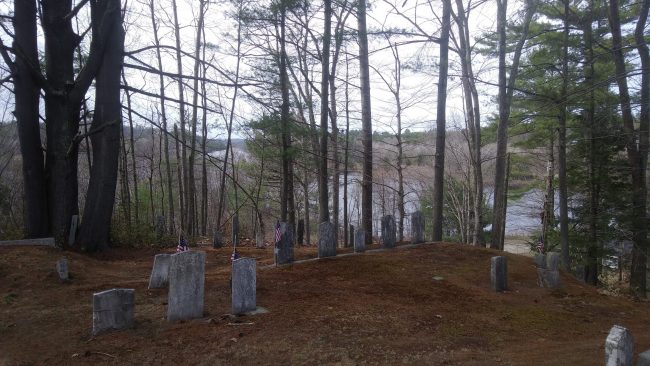
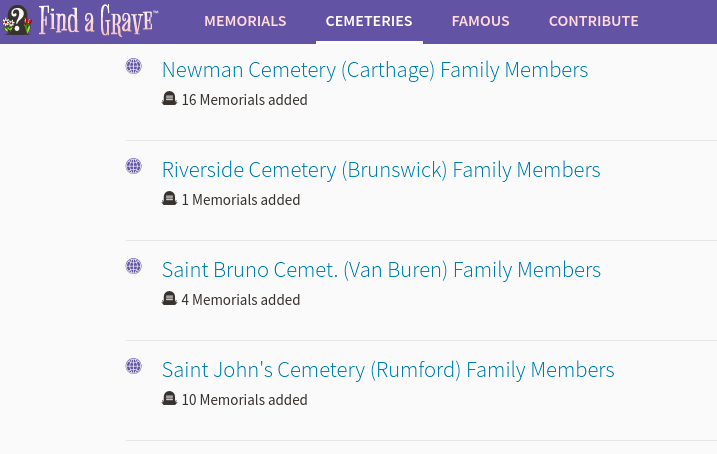
To provide an easy list of who I’m visiting. – When I do get the chance to visit a cemetery where family is buried, life becomes much easier if I can simply open up the link to the virtual cemetery. Remembering the four family members buried in Saint Bruno Cemetery is one thing, but the 10 in Saint John’s? Or the 16 in Newman Cemetery? That gets a bit trickier.
To help give historical societies and cemetery commissions approval for cleaning and resetting stones in my family. – Over the years headstones collect growth, become discolored, topple over, or are slowly eaten up by the earth. In many states it is illegal to clean stones without getting permission from the family or the sexton of the cemetery. As much as I would love to be able to visit and tend all of my family’s stones, that’s an insurmountable task. When I hear of historical societies or cemetery commissions planning work sessions, I always check my virtual cemetery listing to see if I’m related to anyone in the cemetery so I can give proper permission for stone maintenance, and even provide those doing the work with a list.
My 3rd great-grandmother’s stone looks like it could use a little love. If I hear of someone working in Greenwood Cemetery before I get there, I’ll make sure they check on her stone. (Photo Credit: Gail Kelly)
While virtual cemeteries may seem a bit hokey to some, they can most certainly serve a purpose. From providing a list of who to “call on,” to making a virtual graveyard of interesting celebrities, everyone can find a reason to make these little memorial oasis.
Anytime you hire someone, it helps to know a little bit about their field of occupation. Here are some of the key things to keep in mind about professional genealogists when working with one.
We use the same records as you do and then some. Professional genealogists also make use of Ancestry, FamilySearch, My Heritage, FindaGrave, and other online resources. Despite when some believe, professional genealogists do not have access to special archives designed only for professionals. What we do have is extensive knowledge of how to use the catalogs these systems have, where to find obtuse information, and the love for digging through virtual tomes that aren’t indexed digitally.
Quality work is time consuming. In order to make sure that the right documents are cited, the correct family tree climbed, and the questions answered as fully as possible, copious amounts of time is spent doing genealogical research. Some days the document that is being hunted might be on page three of a digital book, other times it may be page 400, written by hand, and in French, not to mention poorly photocopied. In order to make sure a genealogical question is answered in a manner that fits the genealogical standard, a professional genealogist must be thorough — which takes time.
Specific objectives help us do our work. Simply asking a professional genealogist to build your family tree is a very vague task; asking them to find evidence of the marriage between your sixth-great-grand parents on your maternal side with the last name or Arsenault is fantastically specific. Ever individual researched takes up time. If you want a professional genealogist who can help you in a timely manner, you objective should be specific. If it needs to be broader, that’s something to be decided on when talking over the scope of the project.
Your past research helps us do our job. Any research you have done is important to share with whoever you hire to do professional genealogical work. This is not a time to “test” the professional genealogist by seeing if they find the same documents — for one, that’s just rude, and for two, you’re wasting your money and the genealogist’s time. Being forthcoming and honest about the research you have done, providing copies of any documents and notes you may have, and being receptive to feedback about what you have collected is a wonderful way to ensure a firm working relationship with the professional genealogist you hire.
We love to hear stories, but we won’t use them in our research. Documentation and facts that can be presented trump family stories every time. Yes, you were told that your fifth-great-grandmother Winnie was a Cherokee Princess, but if the documentation isn’t there…..it’s just a story. Be prepared for professional genealogists to hold a firm line on that.
We are real people! While it would be fantastic if professional genealogists had a magic wand that could make documents suddenly fly off the shelves and into our hands, the reality is that such a thing can’t happen. Professional genealogists may spend hours looking for a document online, calling archives, visiting libraries, only to have to form the conclusion that the document doesn’t exist. Other times, answering even the most specific objective may take far longer than one block of time. Professional genealogists will always do their best to gather the most information possible during the time requested.
Ancestry, FamilySearch, Heritage Tree, and WikiGenes all exist to help make genealogical research easier for the do-it-yourselfer. There are also countless social media groups filled with “angels” who will do the work pro-bono. Some surnames are even lucky enough to come with genealogical website already created online – it’s like you’ve struck gold!
Why hire a professional genealogist? What can a professional genealogist do for you that you can’t do for yourself?
Let’s take a look:
TIME. Genealogy is a very time intensive hobby. While filling out your family tree can seem easy, it’s more than just clicking on hints and copy and paste. In order to have an authentic family tree, with well documented research, primary sources are a must! Primary sources are the documents that prove the information in your tree (such as birth place and time, death and burial locations, marriage certificates, military history, etc.). While some of these documents are indexed online, many aren’t, and it can take hours combing through to find what is your ancestor’s breadcrumb trail. Professional genealogists know the most efficient methods to gather those documents in a timely manner.
BRICK WALLS. When researching your family, there can be a series of brick walls that come up – areas where you just can’t get through to the other side to continue on. While many documents are online – some indexed and some not – there still exist many that are only kept in paper form. This is when paying a genealogist in the area where your brick wall is located may come in handy. Professional genealogists can do the “boots on the ground” work, digging through libraries, historical societies, and town offices.
LOCAL KNOWLEDGE. If your family tree takes you to an area you’ve never heard of – and in many cases it will – it might make you wonder what life was like in that area. Finding genealogists from specific locations can be akin to finding a living historian. Many have spent copious hours researching their home towns and state. Professional genealogists can help give others a more well rounded understanding of what life was like in the area and help provide more depth to family history and culture.
LINEAGE SOCIETY APPLICATIONS. There is no cookie-cutter application when it comes to lineage societies. Each has their own application and specific requirements. Professional genealogists can help track down the documentation needed for these applications in a timely manner.
AN EXTRA SET OF EYES. Remember doing assignments in grade school? You’d pass them in, fully sure of yourself that you got everything right, that nothing was missing, only to get it returned with a lower grade than your expected. “If only I had another set of eyes to look at this.” Genealogy is the same way. We look over the same documents, census records, town reports, over and over — and sometimes we miss things. Hiring a professional genealogist to look over your own notes and records, to see if there’s something you missed, is akin to being an author and hiring an editor. You might not think it’s necessary, but you’d surprised at what you could be missing.