Tag: Maine

Judkins Family Stories

The Judkins Brothers

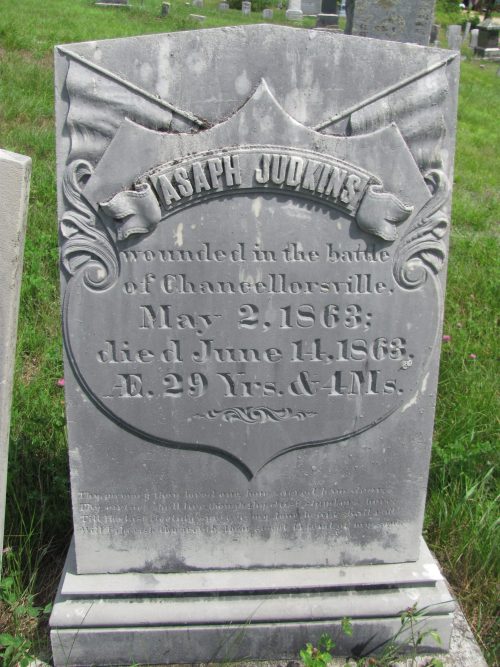
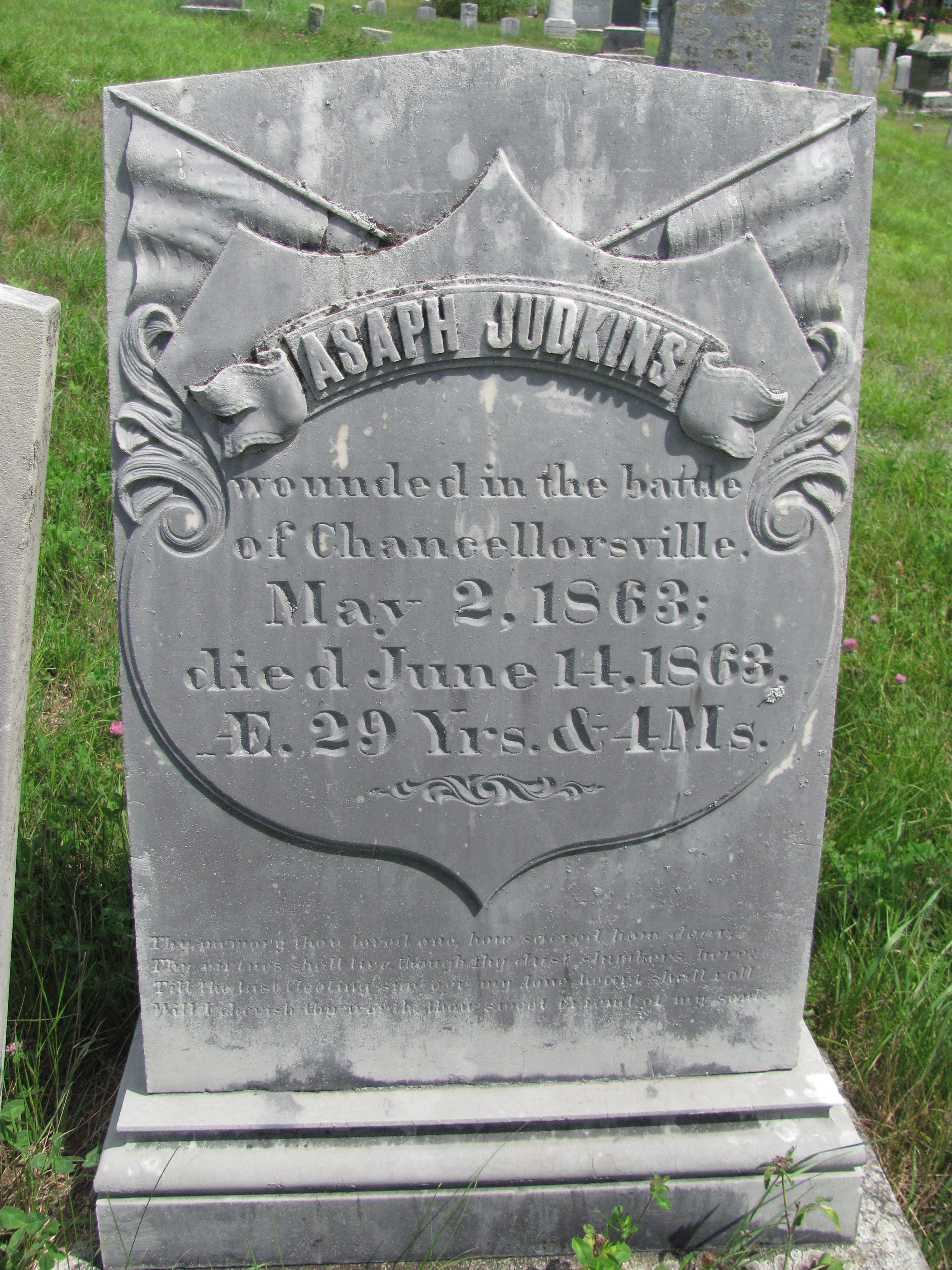
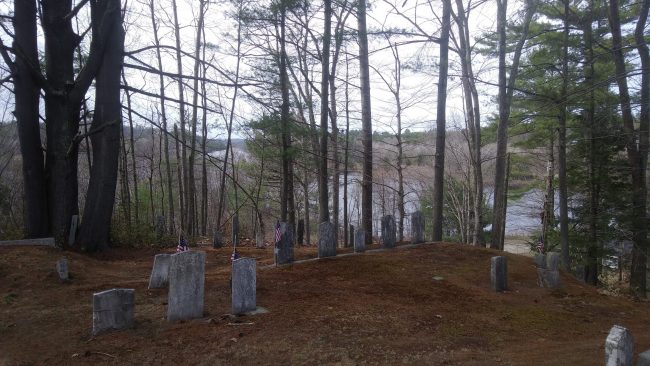
Asaph Judkins is the only brother lost to the Civil War to have a stone at Newman Cemetery.
Photo credit: Gail Kelly

Growing up I always had a love for learning about the Civil War. It was an insatiable thirst which had no tangible reason to exist. Maybe it was because it was a war that held so much promise to bring our nation even closer together, to create a more just and stable union, a country for all people – and utterly failed. (If you don’t understand that last part, study the Antebellum years. A lot of schools in the US gloss over that and you’ll find out why.) Or it could have been that the war brought to a head the concept that a nation so large is bound to hold varying, and sometimes disastrously so, difference in morals and political views, an issue that still lingers. As a student, and now a parent, I feel that the Civil War is never studied deeply enough, especially when many of our nation’s current issues are rooted so tightly to the outcome and lack of follow-up from that war.

So, being partial to the time period of the Civil War, I tend to keep an eye out for family members that may have fought during the time. With Memorial Day drawing near, I felt it fitting to share one of the family stories that I have uncovered over the years.

Philip and Rachel (White) Judkins are my 5th great-grandparents. Married in Weld, Maine, on Dec 6, 18291, the Judkins had seven children born between 1831 and 1846.

i. Orrin Judkins b. 18312
ii. Willard W Judkins b. 1831
iii. Asaph Judkins b. 1834
iv. Irene Judkins b. 18363
v. Benjamin Judkins b. 1839
vi. Eastman Judkins b. 1840
vii. Mercy Ann Judkins b. 18464

Given the dates of birth, it’s easy to figure that at least one, if not multiple, of the brothers would be in the Civil War was a bit obvious. What was surprising it that all five of the Judkins brothers fought in the Civil War.

Orrin Judkins, the oldest brother, had moved out of Carthage early on. After marrying in Boston, he and his wife (Ellen Dinan)5, moved to Wisconsin6, where they were living when he mustered into Company B of the 23rd Wisconsin Volunteers. He left for the war leaving his four children and wife hoping for his return.7

Back in Maine, Asaph, who was living in Lewiston8 with his newly wedded wife in 18609, volunteered for service. He found himself in the Company H of the 10th Maine Infantry with his brother Willard.10 While Asaph and his wife had not yet had time to start a family, his brother Willard left wife Melissa with three boys to tend to and expecting a fourth.11

In 1860, the youngest two of the Judkins brothers, Benjamin and Eastman, were still living on the farm. they also signed up for the war. Eastman found himself in the same company as Asaph and Willard.12 Benjamin was placed in Company E of the 32nd Maine Infantry.13 Neither of the younger brothers were married.

Five brothers went into the Civil War. Only three came back.

Asaph, Willard, and Eastman all began in Company H of the 10th Maine Infantry as privates, but when the company was restructured after the leaving of some men mustered out, their company was changed to Company B. In the new Company B, Asaph and Eastman remained privates, but Willard was promoted to corporal.14 With all three brothers in the company, the ensemble arrived at Chancellorsville. On May 2, 1963, “strolling about at will, or lying under the trees, enjoying the delightful air and sunshine” (from History of the First-Tenth) when they were attacked by a rebel battery. Asaph, would had been sitting on the bank of the river, was severely wounded in his foot by a shell fragment. “Two men remained with him until he was taken in charge by some surgeon.”15 One can only imagine that these “two men” were Willard and Eastman, knowing how disastrous a foot injury could prove at that time. Unfortunately, Asaph developed gangrene from his injury and died June 14, 1863.16

Eastman and Willard would continue on with the 10th Maine until Company B joined on with the 29th Maine. Willard received another promotion and became a sergeant of Company F during his remaining time17, while Eastman remained a private in Company H.18 The brothers mustered out on January 11, 186519 and May 21, 1865,20 respectfully. They would be the only two of the Judkins boys to make it out of the war.

Orrin, the eldest of the Judkin brothers, passed away roughly a month before brother Asaph. While marching with Company B of the 23rd Wisconsin Infantry, the only unit he served with, Orrin was taken ill with “chronic diarrhea,” which more than likely was dysentery. Like many soldiers killed in the Civil War, his death didn’t come from a bullet. Orrin Judkins mustered out of the military due to death from illness on April 10, 1863,21 at Van Buren Hospital in Millikens Bend, Louisiana.22 His wife was left to fight for his pension, tend a farm, and raise four young boys on her own.23

Benjamin Judkins suffered a similar fate as his brother. As Company E and the rest of the 32nd Maine pushed had on the march to Cold Harbor, “the severity of the march, pursued with such rapidity beneath a burning sun, and along scorched and dusty roads, had exhausted the strength of some. And from this cause, there were losses by so-called “straggling”, as in many cases men who were worn out and wearied beyond the power of endurance, were unable to keep up with the swiftly-moving columns, and compelled to fall out.” It’s easy to imagine that many of these soldiers were not only exhausted, but were also malnourished and/or dealing will illnesses such as dysentery. While the 32nd Maine avoided conflict during this period, many of those men who fell out of line were captured by the Confederates, including Benjamin Judkins.24 It was recorded that Benjamin died in Libby Prison on June 30, 1865, from disease.25

In an unfortunate twist of fate, both daughters of Philip and Rachel Judkins also passed away during the time of the Civil War. Mercy Ann died at the age of 15 on January 3, 1862,26 unwed. Irene (Judkins) Whitney passed away on September 18, 1860,27 leaving behind a husband and two sons.


This blog entry was written as an expression of love and remembrance for those who have died in war.

To Orrin, Asaph, and Benjamin, I say a well belated thank you for your greatest sacrifice. May you rest in power and peace.


1 Maine Marriages, 1771-1907, database, familysearch.org.
2 New England Historic Genealogical Society; Boston, Massachusetts; Massachusetts Vital Records, 1911–1915, p. 156
3 Philip Judkins household, 1850 US Census, Carthage, Franklin Co., Maine, pg 37.
4 Philip Judkins household, 1860 US Census, Carthage, Franklin Co., Maine, pg 13.
5 New England Historic Genealogical Society; Boston, Massachusetts; Massachusetts Vital Records, 1911–1915, pg 1562.
6 Orrin Judkins household, 1860 US Census, Kendall, Lafayette Co., Wisconsin, pg 12a.
7 The National Archives, case files of approved pension applications of widows and other veterans of the army and navy who served mainly in the Civil War and the War with Spain, compiled 1861-1934, roll WC32884-JUDKINS-Orrin, image, familysearch.org.
8 Asaph Judkins household, 1860 US Census, Lewiston, Androscoggin Co., Maine, pg 99.
9 Maine Marriages, 1771-1907, database, familysearch.org.
10 Gould, M. J. M., & Jordan, R. L. G. (1871). The History of the First-Tenth-Twenty-Ninth Maine Regiment in Service of the United States from May 3, 1861, to June 21, 1866. Portland: Stephen Berry. pg 328.
11 Willard Judkins household, 1870 US Census, Carthage, Frankly Co., Maine, pg 8.
12 Gould & Jordan (1871), pg 328.
13 (Benjamin’s Unit list)
14 Gould & Jordan (1871), pg 379
15 Ibid., pg 343-344.
16 Ibid., footnote, pg 344.
17 Ibid., pg 627. Mistakenly recorded as “William Judkins.”
18 Ibid., pg 631.
19 US Civil War Soldier Records and Profiles, 1861-1865, database, Ancestry.com.
20 Ibid.
21 US Civil War Soldier Records and Profiles, 1861-1865, database, Ancestry.com.
22 US Registers of Deaths of Volunteers, 1861-1865, pg 51.
23 The National Archives, case files of approved pension applications of widows and other veterans of the army and navy who served mainly in the Civil War and the War with Spain, compiled 1861-1934, roll WC32884-JUDKINS-Orrin, image, familysearch.org.
24 Houston, Henry C., (of Co. C). (1903). The Thirty-Second Maine Regiment of Infantry Volunteers – A Historical Sketch. Portland, ME: Press of Southworth Brothers. pg 258-259.
25 US Civil War Soldier Records and Profiles, 1861-1865, database, Ancestry.com.
26 Gravestone photo, Newman Cemetery, Carthage, Maine, findagrave.com #183851098.
27 Gravestone photo, Newman Cemetery, Carthage, Maine, findagrave.com #183791232.

As with all written pieces of genealogical research, the findings in this piece are subject to change based on new evidence as it becomes known.
Tips and Tricks

Virtual Cemeteries

Websites such as Findagrave, Billiongraves, and CanadianHeadstones have allowed for relatives far off to see photos of the headstones of those who have passed. While leaving virtual flowers has never really blossomed into a routine, answering photos requests for others has, and so has building virtual cemeteries.

Those new to the realm of headstone digitization may be scratching their head asking, “What the hell is a virtual cemetery?” The easy answer is this: virtual cemeteries are bookmarks of where friends and family are buried. (Some people even create virtual cemeteries for celebrities that have passed or just interesting stones they find in their ventures.) Findagrave even allows you to create memorials in these virtual cemeteries for pets who have passed, a wonderful touch for those who were unable to buy their pet in a location that can be visited.

As a genealogist, I’ve created virtual cemeteries for others while doing research (only if applicable to the question they want me to answer). I then give them the link to the virtual cemetery and a certain time period in which they can copy the information over. By doing this, I give them something a bit more fleshed out than just a list of where their family is buried.

For my own personal use, virtual cemeteries hold two purposes:

Virtual cemeteries can prove a wonderful tool when visiting memorials, especially if you have plenty of family in one spot. You don’t need the spirits gossiping about why you forgot to visit your great aunt, but spent an hour with your drunk of an uncle the next plot over.
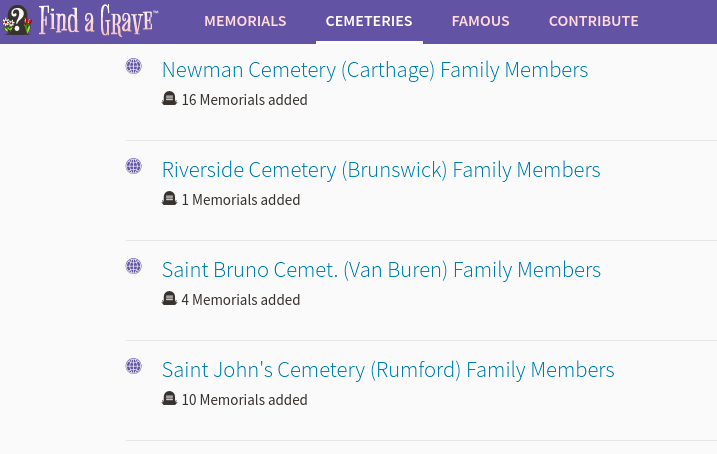
  1. To provide an easy list of who I’m visiting. – When I do get the chance to visit a cemetery where family is buried, life becomes much easier if I can simply open up the link to the virtual cemetery. Remembering the four family members buried in Saint Bruno Cemetery is one thing, but the 10 in Saint John’s? Or the 16 in Newman Cemetery? That gets a bit trickier.


  2. To help give historical societies and cemetery commissions approval for cleaning and resetting stones in my family. – Over the years headstones collect growth, become discolored, topple over, or are slowly eaten up by the earth. In many states it is illegal to clean stones without getting permission from the family or the sexton of the cemetery. As much as I would love to be able to visit and tend all of my family’s stones, that’s an insurmountable task. When I hear of historical societies or cemetery commissions planning work sessions, I always check my virtual cemetery listing to see if I’m related to anyone in the cemetery so I can give proper permission for stone maintenance, and even provide those doing the work with a list.
My 3rd great-grandmother’s stone looks like it could use a little love. If I hear of someone working in Greenwood Cemetery before I get there, I’ll make sure they check on her stone. (Photo Credit: Gail Kelly)

While virtual cemeteries may seem a bit hokey to some, they can most certainly serve a purpose. From providing a list of who to “call on,” to making a virtual graveyard of interesting celebrities, everyone can find a reason to make these little memorial oasis.

The Why

Photos

“Army Recruits, Lewiston City Hall, 1918” – shared from the Franco-American Collection
via Maine Memory Network.

“Photography takes and instant out of time, altering life by holding it still.” – Dorothea Lang

We see photos all the time. Nowadays, they’re mostly on our phones. We slide left or right, post to social media, send to friends and family, store in the cloud…but how often do we actually look at photographs anymore? Not the snapshot of your morning coffee, or Jared’s pic from lunch, but the photographs that hang on the walls of our family members?

I remember my parents having very few photos on our walls growing up. The first place we lived at there was always our school photos and maybe a few photos of cousins, but when we moved they all disappeared, put into boxes and drawers. But my grandparents’ homes, that’s where I remember seeing photos. Pictures of family members, buildings, events; stories from a time pre-me.

The mind is a funny thing. When I think of the place where my Nana lived, I picture the house her and my grandfather lived in when I was in grammar school, but when I think of the Wall of Photos, it’s the hall in their apartment years later that comes to mind.

In Nana’s apartment there was a long hallway. I have some memories to running up and down this hallway at three-year-old breakneck speed as my parents lived in the same apartment long before Nana and Grandpa lived there. As Nana’s hallway, though, it held a different fascination. I was no longer concerned with how fast I could rush down it, but just how far down the hallway I could make it. You see, that hallway led to the bedrooms, which was Sacred Ground and none of the grandkids were allowed into, and by proxy, the hallway was somewhat off limits, or at least that’s how it felt growing up. That hallway was a temptation. Between the two walls of paneling was a portal to an era I barely knew: the Time Before Me.

Photos of my nine aunts and uncles echoed down through. There were senior photos of some of my aunts and uncles, but not all. (I remember wondering if this was Nana’s way of playing favorites, a subtle hint to when one of her children displeased her, but I don’t recall the photos ever being rearranged.) There were a few family photos, staged before the town gazebo which was so small that it was concealed behind my father’s large family. Still others were of great-aunts and -uncles who I never knew.

The photos hung at Nana’s house – and the ones in frames hidden among the knicknacks – seemed like little shrines. There were things too sacred for anyone as young an inexpereinced with the world such as myself to ask about. It was a bold contrast to the pictures at Grammy’s.

I don’t recall visiting my Grammy and Grampy, my mother’s parents, much growing up. They lived a couple hours drive from us and my childhood took place at a time where up and driving two hours for a visit would have meant either a very late night back or staying the weekend, neither of which were options for our family due to my parents’ business. However, I was ecstatic when they moved into the same town as us, and even more excited when they eventually moved into an apartment on the road right behind us. My brother and I could go visit them and my mom could literally call down the hill to let us know it was time to come home for lunch. Grammy always had treats in the house – aside from Grampy’s licorice jelly beans that I always mistook for the colorful, far superior fruity flavored ones, much to his glee – and entering their living room was like entering into a living, breathing family tree.

Photos of cousins who I recognized were displayed on one wall. Another held the graduation photos of my mother, her older sister, and her younger sister and brother. (Those four photos were an interesting variety of styles as mom and her older sister graduated in late 1970s/early ’80s, her brother in the late ’80s, and her youngest sister in the mid-’90s. It was like a timeline.) Above the entertainment center, which was mixed shrine of gifts from family members and Red Sox paraphernalia, were two photo collages that I hope will never fade from my memory.

One photo collage was of more recent photos. It was easy to pick out Grammy, as she hadn’t really changed in the decade or less that many of the pictures were taken. Unlike at Nana’s, these pictures looked like conversation starters, and that they were. Names, places, stories of family reunions, who was mad at who at who and for why and how long, and where people were living, the names of their children, and what they did for work would all just start rolling off my Grammy’s tongue. The stories of people I never met would fascinate me in a way I don’t think she ever knew. I loved hearing about her side of the family, who seemed so alive that collage.

The other collage. What a contrast. All the photos in that one, at least that my memory recalls, were black and white. They looked like secrets. I would ask about the pictures and be told what they were. One was of my Grampy and his brother in the army in Germany during Korea. Another of them as kids with my great-grandfather. There was one of my great-grandmother as well. The photo of the homestead in Nova Scotia has always intrigued me. Unlike asking about Grammy’s collage, which started a fountain of stories, asking about these only brought answers sufficient enough to answer the question at surface value. It only whetted the appetite for the stories behind the photos. That’s when I started getting interested in history.

Who were these people in the photos with the untold stories? Where did they come from? Why did some of them seem so sad, dejected in a way, like the world simply wasn’t meant for them? What about past those photos? How did those photos come to be – what life events spurred my grandfather into the army, for his father to leave Nova Scotia?

Photos trigger emotions – fear, sadness, joy. They also trigger our curiosity. If it hadn’t been for the snapshots of the past that adorned my most recent ancestors walls, I might never has started hunting down those that came before me. These glimpses of everyday life whetted my appetite for the stories behind them. Even now I love coming across photos of family members that I have never seen before. It keeps that spark of wanting to learn more alive.

Maine Places

Mercy Hospital

Mercy Hospital in Portland, Maine. Photo found at MaineMemoryNetwork.com

Known today as one of Maine’s most renowned hospitals, Mercy Hospital started as a result of the 1918 Spanish Influenza. During a time of fear and illness, a lack of adequate hospital facilities lead Bishop Walsh to found The Queen’s Hospital with the help of the Sisters of Mercy, whom the hospital was later named after.

Established in 1831, the Sisters of Mercy became known for their vows of tending to the sick, poor, and ignorant. Lovingly called “walking nuns” in Ireland, the sisterhood’s country of origin, the Sister of Mercy had their first mission of health with the 1832 cholera epidemic. A little understood disease at the time, cholera ran rampant through Dublin, killing up to 600 people per day. The Sisters worked to help stem the impact of the illness any way they could, from holding the hand of a dying patient to continuing lessons for children pushed out of school.

Over the next decade, the Sisters of Mercy open chapters in other countries than Ireland, including roughly 100 different foundations in the U.S. In 1873 Bishop David Bacon invited the Sisters to Portland to help care for the orphans of the city; had he not, the Sister of Mercy may not have been able to help open the greatly needed hospital during the 1918 pandemic.