
Tag: 1800s

52Ancestors Maine Places

The Search for Julia – Part III

As I’ve shared in The Search of Julia and The Search for Julia – Part II, I’m on the hunt to find one of my 3rd great-grandmothers. She has been a brick wall in my research for a while now, and I figure sharing some of the tactics I use to try to scour out a loose brick to get past this obstacle might help others.

Thankfully, the #52Ancestors challenge has been lending itself well to this.

This post’s prompt is all about maps. Maps are something that many people tend to over look, especially as they can be few and far between in many time periods. One wonderful bonus about living in Maine, however, are the maps at the Library of Congress’ website. In the late 1850s and early 1860s, each county in Maine had a topographical map produced from survey data. Obviously, these maps aren’t necessarily without faults, but they give a great insight as to the people who lived in the towns and counties at the time.

One of the next steps for hunting down the possibly families of Julia Light will be a reverse crawl from these maps.

Given that most of Julia’s married, and most likely pre-married, life took place in Patrickstown Plantation, later known as Somerville, I started by finding the map for the town, in Somerset county.
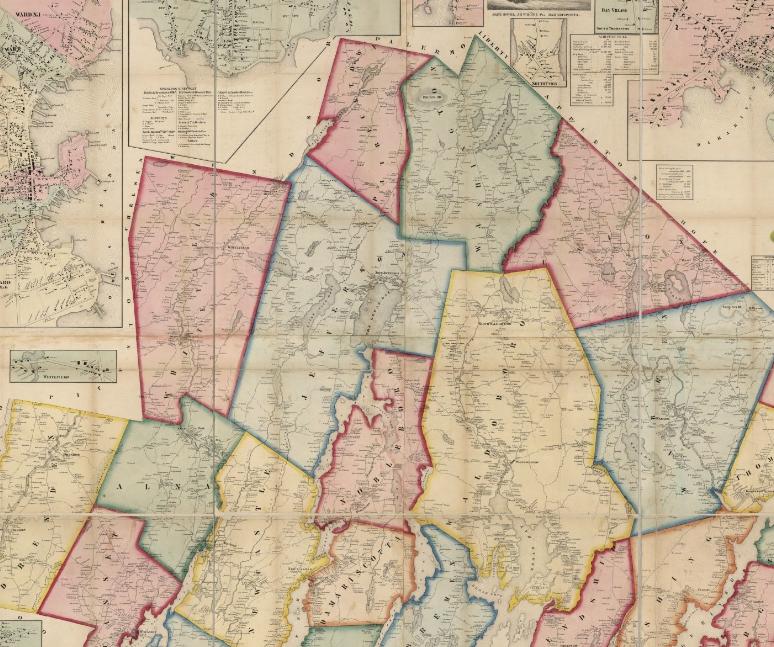
Map of Somerset County, Maine, circa 1857.

By zooming into these maps through the Library of Congress’ interface, I can legibly read the names of the heads of households for the dwellings. This map is from 1857, a long ways after Julia Light was born in 1820, but the names on these maps can certainly give a few potential leads. By looking at anyone with the shared surname of Light living in any of the potential areas in which Julia was born or lived, I can begin crawling back up family trees to see potential connections. While I might not find a direct relation, sometimes even finding a first or second cousin can help lend light on the potential paternal family.

For example, in Washington, the town next door to Patrickstown Plantation, there are at least three homesteads with the surname of Light. These could be brothers, cousins, or uncles of Julia Light. If I can track these names down in the census data and then create a family tree for them going back two to three generations, this might generate some leads. (We all know that in a perfect world census data would be digitized without issue, but that world just doesn’t exist. These maps can give genealogists an idea as to what might be hiding in the census records that weren’t digitized correctly, or families that moved in and out between census records.)

For towns and cities that are more densely packed, the Library of Congress also has Sanborn Fire Insurance Maps that might be able to shed light in the search as well. Unfortunately, areas like plantations out in the middle of Maine aren’t really seen as needing insurance mapping during the time period that those maps were created.


This blog post is done in part for Amy Johnson Crow’s #52Ancestors challenge. To learn more, visit https://www.amyjohnsoncrow.com/52-ancestors-in-52-weeks/.
52Ancestors

The Search For Julia – Part II

(I promise, no cheesy shoe metaphors this time!)

So, as I shared in The Search For Julia, one of the projects I’m currently working on is trying to track down the lineage of my 3rd great-grandmother, Julia Light.

Julia was born in 1819/20 somewhere in Maine. Unfortunately, I have yet to find a copy of the marriage record for when she married Abraham Place, so no information can be garnered there. Also, I am having a field day of a time trying to find vital records for the town that she was married in prior to 1855, and given that she was born in 1819/20, there’s a good chance Julia was married sometime in the late 1840s.

To make things more interesting, the US Census information for the era in which Julia was born isn’t always as helpful as it could be.

Prior to 1850, the US Census only recorded heads of household, typically men, and no other names. (Every now and again a widow, single mother, or spinster would show up on the census, but sometimes even these names would be erased from history and the eldest white male would be names head of household instead of the true, female head of household.)

In order to find someone born in 1819/20 of which the parents are unknown, there is a long process involving census records – especially in Julia’s case as I have yet to find a birth certificate either. This process is where the 52 Ancestor prompt comes into play. When people mention “Branching Out” in genealogy, many thing of going out onto the branches of the family tree, to cousins, aunts, uncles, etc. My mind tends to take that one step farther and I find myself branching into communities, states, and regions.

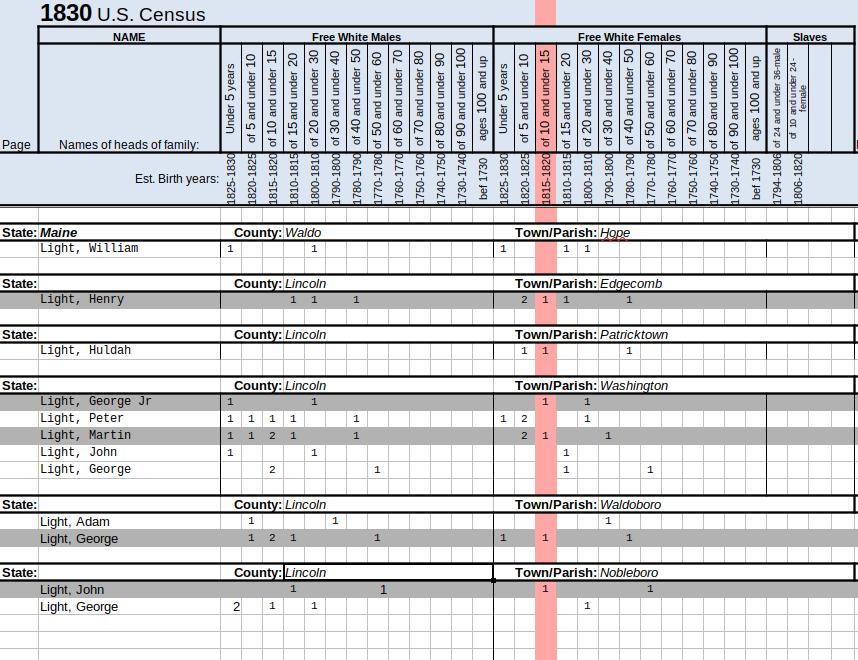
With Julia, this is the path I took: I decided to start branching out into the state as a whole, knowing that the population of Maine at the time of her birth wasn’t that far spread. Taking her estimated age of birth from the 1850s census records, I began looking at households where she would have lived as a teenager. I look through the 1830s census records for entries of young females “of 10 and under 15” years of age.

It needs to be noted that I don’t look at just the census listings for the town that Julia later resided in, Patrickstown Plantation (later known as Somerville), but across the state, as I can find no solid information placing her birth in Patrickstown Plantation. I look at all census records with the same last surname and others that could be a misspelling of the surname. To me, this is like looking up into the canopy of the woods and trying to find the branches of a specific tree. There are so many inter-crossing branches that it’s hard to trace, unless you can take a picture of just those branches and work to trace them back to the trunk.

I gather together the information into a well designed mockery of the actual 1830 census forms.

This allows me to do two things: 1) I can have a better idea as to whether Julia was born in Maine – after all, if I find no families with the same name, then there’s a good chance she was born elsewhere. – and 2) I can more easily find the families that Julia may have been a part of.

Once I can see the families with a young female of the right age, I can then look at the 1840 census data and compare to see which of these young ladies are no longed part of the family. Given that Julia’s oldest child was born in 1837, she would most likely not be living with her parents.

The step after that? Tracing each branch of the same species of tree back to see if I can find the trunk. I’ll be looking at each individual head of household with a young female of the right age listed in the 1830 census but gone in the 1840 census. The hope is that one of these branches will lead to the “trunk,” to the family that Julia was born into.


This blog post is done in part for Amy Johnson Crow’s #52Ancestors challenge. To learn more, visit https://www.amyjohnsoncrow.com/52-ancestors-in-52-weeks/.

52Ancestors

The Search For Julia Light

Have you ever lost something? Like a book or a shoe, and no matter how long you look for it, you just can’t find it? Then, one day, as if by magic or the Universe clicking into place, it miraculously shows up. You should feel a huge sign of a relief that you finally found your shoe, right?

But, no. Instead there is a sudden flood of questions that start collecting in the brain, making it impossible to think of anything else except the lost shoe, now found.

How did you lose the shoe in the first place?
Did the kids take it? The dog?
(When did you even buy these shoes?! They look like something 1980 threw up.)
Why would you not put it where it was supposed to be – on the boot rack with all the others shoes?
And why – and perhaps most perplexing – WHY did it end up in the freezer?

Genealogy can be a lot like a constant game of misplacing and finding items that you lose in your own home. You know somewhere, under the couch or in a lost census file in the middle of the state library, that you will find your answer, just who knows when.

Searching for my 3rd great-grandmother, Julia Light, has been a bit like trying to find that lost shoe.

(Now, before anyone starts shaking their heads or waving fingers in my direction, no, I’m not saying these lives are as “worthless” as an inanimate object, but in order to truly hunt down information objectively my brain treats a subject, in this case Julia, in a similar mindset as a shoe. Once I have a firm grip on the object, or person, from just an information standpoint, than I start looking at them as more of a historical figure to study, and then as a family member who has a story to be told….but all that can be expanded on in another post.)

(Take from Ancestry.com)


When I first started tracing my family tree, I kept finding a lot of holes up one line. That family has had a lot of broken twigs from alcoholism and multiple, nasty divorces, which has made tracing anything an interesting feat. When I finally got back to Julia, I ran into some basic information that was all supposition, except her marriage to Abraham (Abram) Place. Unfortunately, much else was hard to come by, especially since Julia was only found with Abraham in the 1840 and 1850 census records. I had no idea who Julia’s parents were and was having a heck of a time piecing out any information about her. It was like she had only left a footprint – or shoe print – and disappeared.

So, as you do with the shoe you can’t find, you eventually have to give up looking for it for a while. After all, the cats need dinner, cord wood needs stacking, and for some odd reason your chickens think you’re outside only to serve them.

Next thing you know, it’s been over a year and you finally remember about that blasted shoe that you just can’t find. You try looking for it again and BOOM! There it is! Behind the freezer burned gelato from last Yuletide and the left over turkey carcass you keep saying you’ll make into stock.

When I started researching Julia Light again, only a day or two ago, the pieces starting fitting into place, but the more I found, the more curious I became.

Because of when Julia was born, 1820 +/- a year, she won’t be listed in the 1830 census by name. So far I have two possible families that she could be in and will extrapolate on those at a later date. On the same vein, because of the lack of names aside from “head of household” in the 1840’s census, I can only place her in with Abraham Place due to the age bracket checkmarks.

This, for me, is where things get interesting and where my curiosity gets peaked.

In the 1850 census, Julia is listed with Abraham and 7 of their children.

  • Abraham/Abram Place – 39 – M – Farmer
  • Julia Ann Place – 30 – F – Keeping House
  • Abram Jr – 13 – M
  • Isaac – 9 – M
  • Gennett – 7 – F
  • Ann – 6 – F
  • Elisabeth – 4 – F
  • Rose – 2 – F
  • Jacob – 4/12 – M

They are living in Patricktown Plantation, Maine, and are doing the normal farming life that so many others in the town live by. But then, in the 1860 census, there’s only this for a listing:

  • Abraham/Abram Place – 48 – M – Farmer
  • Abram Place – 23 – Farmer
  • Rose – 12
  • Jacob – 9
  • Lucy – 7

Julia Light seems to just disappear from the picture. All her older children are scattered, which makes sense, but she and her youngest (Maria, born in 1857) have disappeared.

Initially, my instinct would have been to assume she passed away and someone else in the family had the baby with them. Whatever happened went down right around the time of the census for 1860 as I can trace all the other children that had left, but can find nothing regarding baby Maria and Julia.

That is, until the 1880 census mortality schedules, which is where I find the following:

ENTRY #8
Name of the deceased person: Place, Julia
Age: 65
Sex: F
Color: W
“Civil condition”: Widowed/Divorced
Born: Maine
Mother born: Maine
Father born: M
Occupation: Laborer
Month of death: Feb
Cause of death: Consumption

*Entry is crossed off with a note at the bottom: “The eleven deaths reported above occurred in this Enumeration District and the family to which the deceased belonged resided June 1st 1880 in this Enumeration district – Except No’s 9-11-8 & 10 died out of this district – but the families to which they belonged were in the District June 1st 1880. There is no physician in nearby town to this district – None nearer than six- and fifteen miles. I am unable to obtain any statements to the above questions from Physicians – but have given correct statements as near as possible by the best information I have been able to receive. – Anson B. Bowler, Enumerator”

In correction box for deaths occurring out of district, the following is amended to ENTRY #8:

PLACE WHERE DEATH OCCURRED
Town: W. Gardiner
County: Kennebec
State: Maine

How and why did Julia end up in West Gardiner as a laborer? The combined check box of “Widowed/Divorced” doesn’t help, either.

So I went back to the 1870 census and stared at the only entry that I had for Abraham Place, one where he has a new wife and a trio of step kids. If Julia Place from the 1880 mortality schedule is my Julia Light, than the check in the “Widowed/Divorced” box must mean “divorced.” Next step? I scoured the vital records for the town. Not a word about Julia leaving or a divorce happening.

Just like wondering how the hell the shoe got in the freezer, I’m puzzling like mad over how the hell Julia ended up in West Gardiner, divorced, and there’s zero record of any of it. My curiosity is still on fire, and I’m going to try to trace back every step I can, but for now, I’m going to refill my coffee and keep plugging away at the rest of the vital records. Maybe, just maybe, a loose-penned town clerk will take the reigns soon and drop a hint as to what went down.

That…and I’m going to set my shoe by the woodstove to thaw out.


This blog post is done in part for Amy Johnson Crow’s #52Ancestors challenge. To learn more, visit https://www.amyjohnsoncrow.com/52-ancestors-in-52-weeks/.